In this article
- The cost formula, before the failure points
- Failure point 1: Evening and weekend silence
- Failure point 2: You are on a job
- Failure point 3: The race against other pros
- Failure point 4: Photos nobody reads
- Failure point 5: The phone number is not the customer’s
- Failure point 6: A long thread that never becomes a call
- A five-minute self-audit
- What automation does not fix
- Frequently asked questions
- People also ask
- Sources
- Find out what your leads cost you
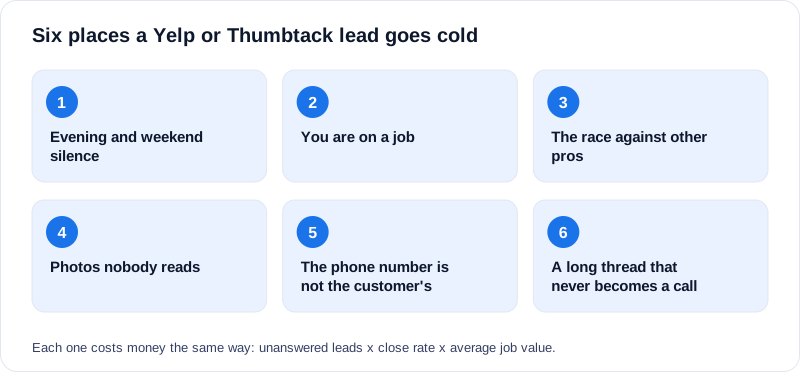
A Yelp or Thumbtack lead goes cold when the customer hears nothing useful from you before they hear from someone else. For home-service pros it usually happens in six predictable places: evenings and weekends, time spent on a job, the race against other pros, photos nobody reads, phone numbers that do not work, and message threads that never turn into a call. Each one has a fix, and most of them are not about working harder.
Here is the data behind one of them. In our own sample of 1,275 Yelp and Thumbtack leads, 46% of Thumbtack leads and 22% of Yelp leads arrived with photos attached (257 of 556 Thumbtack leads and 157 of 719 Yelp leads; measured August 2026). A reply that only reads text misses that information on close to half of Thumbtack leads. More on that in our Thumbtack auto-responder guide and the full photo data.
For the research behind these numbers, see what speed-to-lead studies actually say.
The cost formula, before the failure points
Every failure point below costs money in the same way, and it is worth writing the formula once:
Lost revenue per month = leads that go unanswered in time × your close rate × your average job value.
An illustration, not a measurement of any customer: if 10 leads a month go unanswered in time, you close 20% of the leads you do answer, and an average job is $300, that is 10 × 0.20 × $300 = $600 a month in jobs you never had a chance to win. The lead response calculator lets you put your own numbers in. On Thumbtack you also paid for those leads, so the unanswered ones cost you twice.
Failure point 1: Evening and weekend silence
What happens. A customer submits a request at 9 p.m. and sees nothing until morning. By then they have messaged other pros.
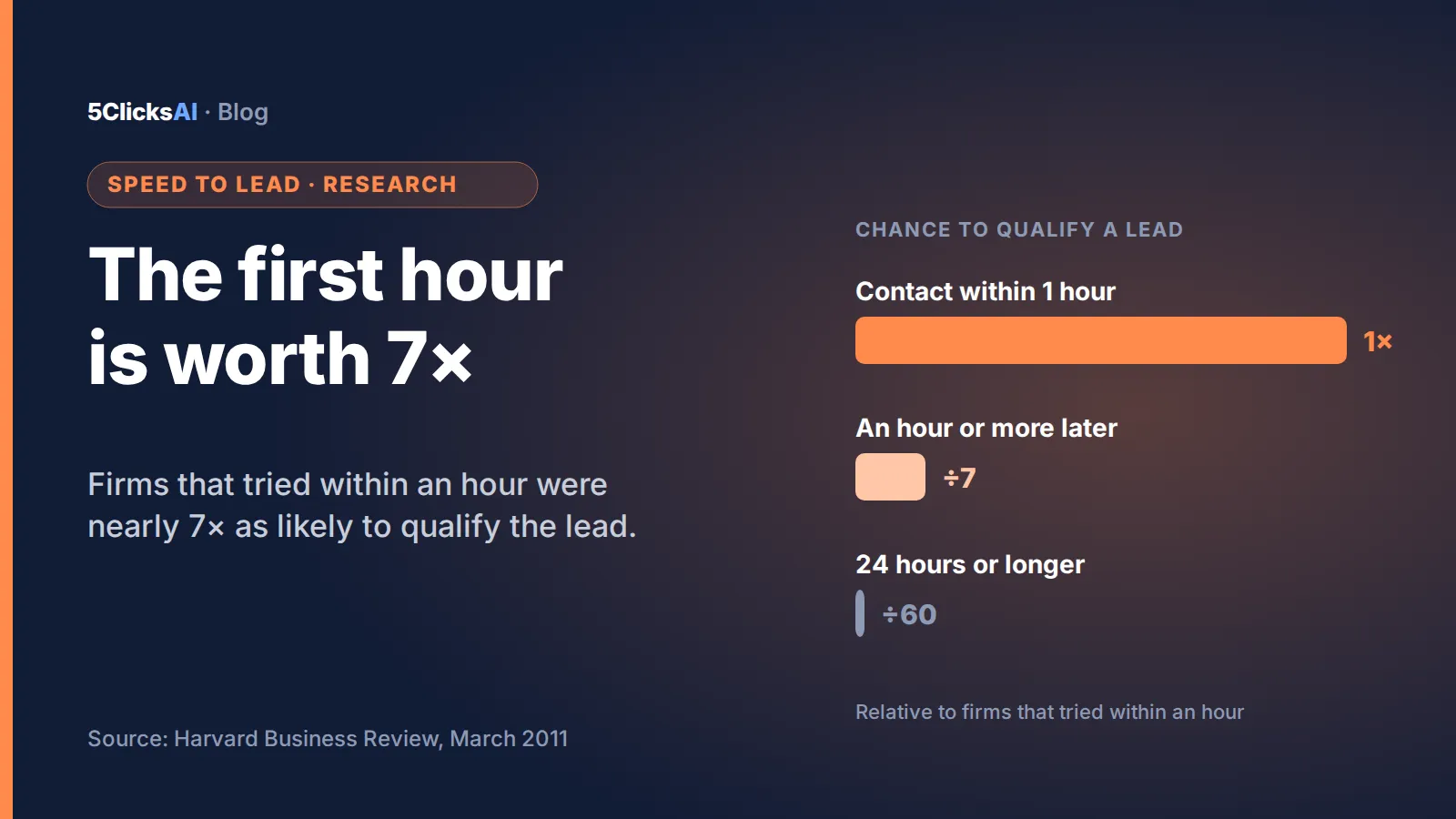
Why it hurts. Leads do not follow office hours, and the pro who is asleep loses to the pro who answered. Research on online sales leads points the same way: in the 2011 Harvard Business Review study The Short Life of Online Sales Leads, which audited 2,241 US companies, firms that responded within an hour were far more likely to qualify a lead than those that waited longer, and many companies never responded at all.
Fix. Either cover the evening yourself or automate the first reply. An HVAC owner who uses 5clicks.ai told us: “Evening leads used to sit until morning, and by then the customer had already found someone else. Now it replies instantly, even when I’m on a job.” (Individual results; outcomes vary by trade, market and lead quality.)
Failure point 2: You are on a job
What happens. You are under a sink, on a roof or in an attic. Your phone buzzes in the truck.
Why it hurts. The best time to answer is exactly when you cannot. Replying from a job site means half-sentences and missed details.
Fix. A first reply that does not need you, plus a text and a call alert when the customer is ready to talk. A general contractor put it this way: “The main thing – no more leads lost on weekends. I step in myself for odd questions, but rarely.”
Failure point 3: The race against other pros
What happens. The customer is comparing. On Yelp, Request a Quote lets a customer send one request to several similar businesses. On Thumbtack, customers pick pros from their search results and can reach out to more than one, and Thumbtack even labels a lead “Only picked you” when the customer has not contacted any other pro yet.
Why it hurts. The customer is comparing. A slow, polished reply often loses to a fast, decent one.
Fix. Be the first useful answer, not the perfect one. Ask for a phone number in that first message. Yelp shows response time and response rate publicly on your business page (see how Yelp calculates them), and Thumbtack says your response rate affects your rank in its search results (see how Thumbtack leads work).
Failure point 4: Photos nobody reads
What happens. The customer attaches photos of the leak, the unit or the damage and writes almost nothing.
Why it hurts. A text-only tool or a rushed human reply asks for details the customer already sent. Sometimes there is nothing to answer at all, and the lead is lost to silence.
Fix. Use a tool that reads attachments at the moment the lead lands, and check how it handles a lead with photos and no text. Yelp attachment links can expire within minutes, so reading later is not reliable.
Failure point 5: The phone number is not the customer’s
What happens. A number arrives on the lead, you call, and nobody picks up, or the number is not the customer’s own line.
Why it hurts. Yelp and Thumbtack often attach an intermediary number rather than a direct one, so “we already have their number” is false comfort.
Fix. Ask for a direct phone number in the conversation, every time. This is why our replies work toward getting one before handing the lead to you.
Failure point 6: A long thread that never becomes a call
What happens. Message after message about scope, availability and small details, and the customer drifts away.
Why it hurts. No software knows every detail of your business, and a long back-and-forth is not how home-service jobs get booked. A short exchange followed by a call, or a free on-site diagnostic, usually is.
Fix. Keep the written exchange short: what the job is, then a phone number. With two-way call initiation on, 5clicks.ai calls you and connects you with the customer as soon as they write, so you are talking within minutes instead of typing. A landscaper described the volume problem: “In season it’s a flood of requests, you physically can’t reply to everyone. The AI filters out the ‘just browsing’ ones and only warm leads reach me.” (Individual results.)
A five-minute self-audit
- Open your last 20 leads and mark which arrived outside business hours.
- For each, note how long the first reply took.
- Count how many included photos and whether your reply mentioned them.
- Count how many of your phone calls reached a person.
- Multiply the unanswered-in-time leads by your close rate and average job. That is your monthly number.
What automation does not fix
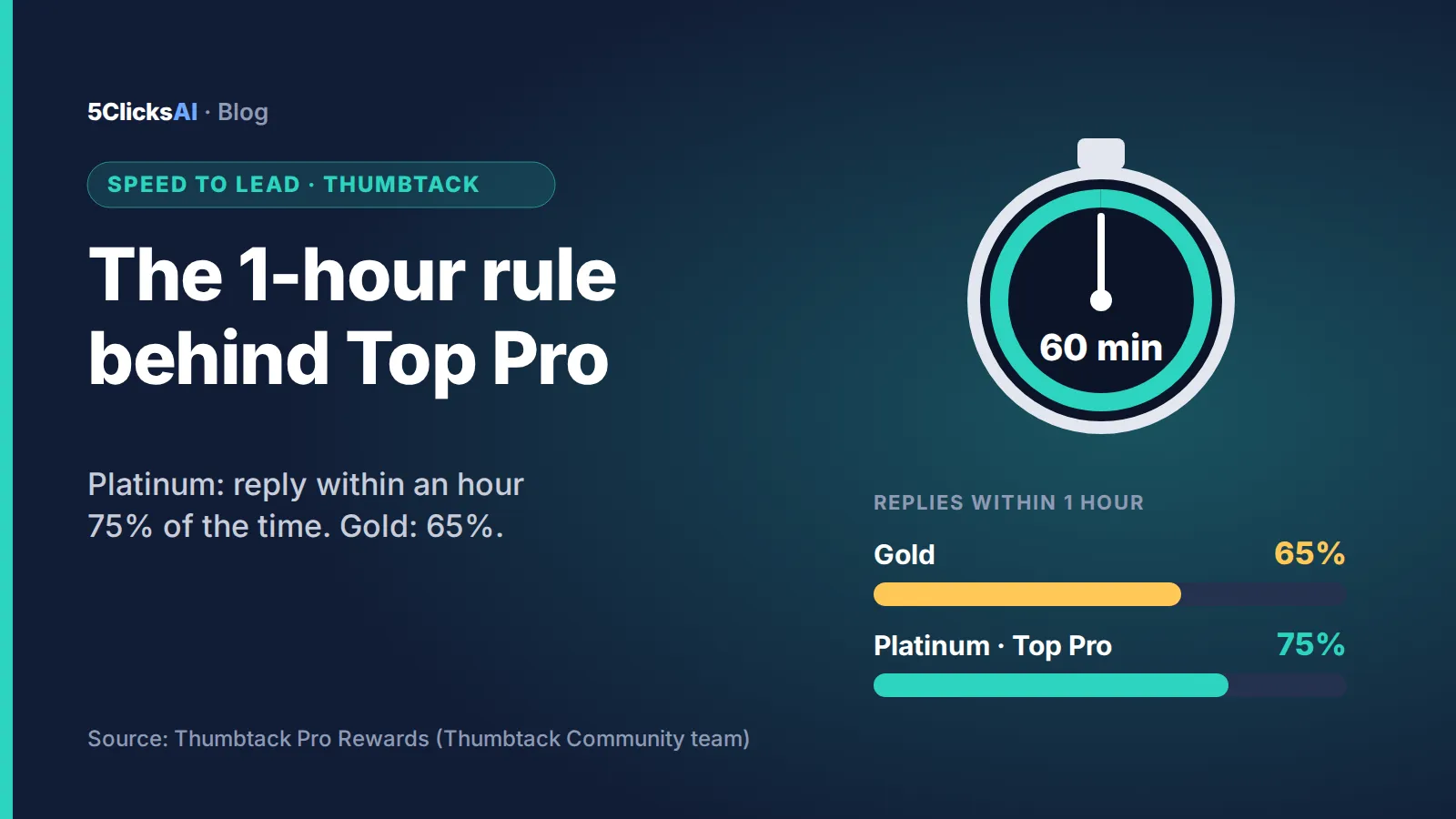
Before choosing a tool, compare Thumbtack’s built-in tools, AI auto-responders, answering services and doing it by hand, and check the one-hour rule in Thumbtack Pro Rewards.
- It does not create leads. It answers the ones you already pay for.
- It does not change your ranking on Yelp or Thumbtack.
- It does not book jobs or quote prices; it has no access to your calendar.
- It does not replace the conversation with the customer; it starts it and hands it to you.
Frequently asked questions
Why do home-service leads go cold so quickly?
Customers usually compare several pros, so the first useful reply tends to get the conversation. A slow reply competes with one that already started.
What is the most common reason contractors lose Thumbtack leads?
Slow first replies, especially outside working hours and while on a job, followed by replies that ignore the photos the customer attached.
How fast should I reply to a Yelp or Thumbtack lead?
As fast as you can. The Harvard Business Review lead-response study found that responding within an hour was linked to much higher odds of qualifying a lead than waiting longer, and minutes are safer on shared leads.
Should I call the customer or message them?
Both, in that order: a short message to acknowledge the request and ask for a direct number, then a call.
Does an auto-responder work for every trade?
It works best where leads arrive as messages while you are busy: HVAC, plumbing, electrical, cleaning, appliance repair and similar. If almost all your customers phone in, a human answering service may fit better.
People also ask
- Why is nobody answering my Thumbtack leads? Common causes are slow first replies and numbers that reach an intermediary line.
- How do I stop losing leads at night? Automate the first reply and set up a text and call alert for when a customer is ready.
- Do customers see how fast I respond on Yelp? Yes, response time and response rate are shown on your business page.
- How many Thumbtack leads include photos? In our data, 46% (257 of 556; measured August 2026).
- What should the first message to a lead say? Acknowledge the job, ask one question about it, and ask for a phone number.
Sources
- Oldroyd, McElheran & Elkington, The Short Life of Online Sales Leads, Harvard Business Review, March 2011.
- 5clicks.ai: lead photos data, 1,275 leads, measured August 2026.
- Owner quotes are from customers of 5clicks.ai and reflect individual results.
Find out what your leads cost you
Built by a marketing agency that’s run Yelp and Thumbtack for 5+ years. 5clicks.ai answers new leads day and night, reads the photos, and connects you with the customer.
Connect your account and see it on real leads →
Part of our guide: Thumbtack auto-responder for home-service businesses